
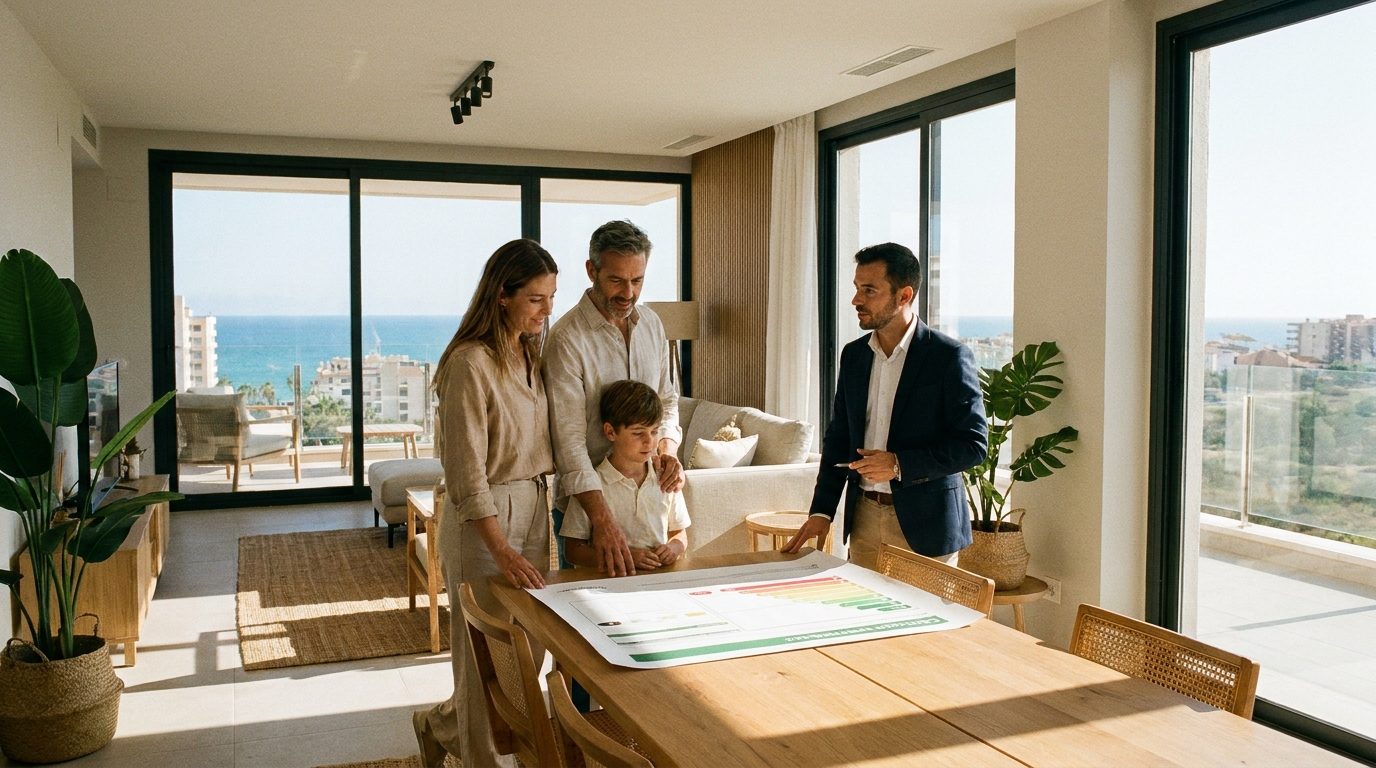
The energy certificate is an official document that provides information on the energy consumption and CO2 emissions of a home. It functions like an appliance label, rating the property's efficiency with a letter from A (most efficient) to G (least efficient). This report is mandatory for selling or renting any property in Spain.
- Mandatory: Necessary to advertise, sell, or rent a home.
- Validity: It is valid for 10 years from its issuance.
- Rating: Uses a letter scale from A (green, very efficient) to G (red, not very efficient).
- Process: Carried out by a qualified technician (architect or engineer) after a visit to the property.
So, what exactly is the energy certificate and what is it for?
To put it simply, the energy certificate is like your home's ID card in terms of efficiency. It's a detailed report that not only assigns you a letter but also describes your home's energy characteristics: the insulation of walls and windows, the type of boiler or air conditioning system you have, and how much energy it consumes to maintain a comfortable temperature.
Its main function is to inform. If you are going to buy or rent a house in our Torrevieja area, this document gives you a very clear idea of whether that home will be expensive to heat in winter or to cool in our hot summers. For sellers, although a bad rating does not prevent a sale, offering an efficient home is an increasingly powerful selling point, especially for European buyers accustomed to valuing this aspect. In our catalog of properties on the Costa Blanca, it is information we always provide.
Is the energy certificate mandatory in Torrevieja?
Yes, without a doubt. Since the entry into force of Royal Decree 235/2013, the energy certificate is mandatory throughout Spain, and of course, in Torrevieja, Orihuela Costa and the entire Comunitat Valenciana. You must have it available from the moment you put your property on the market, whether for sale or rent. In fact, the energy label must appear in any advertising.
Furthermore, it is an essential document that the notary will require at the time of signing the sale. Not having it can lead to significant administrative sanctions, ranging from minor to serious fines. In the Comunitat Valenciana, the body responsible for registering these certificates is the Instituto Valenciano de Competitividad Empresarial (IVACE). The technician you hire will be responsible for carrying out this registration for you.
How is the certificate obtained and how much does it cost on the Costa Blanca?
Obtaining the energy certificate is a fairly simple process. Here's a summary in several steps:
- Contact a certifying technician: You must look for a qualified professional, such as an architect, technical architect, or engineer. You can ask for recommendations or search professional associations.
- Property visit: The technician will visit your home to take data: they will measure surfaces, check the type of windows, the thickness of the walls, insulation, and analyze the heating, cooling, and hot water installations.
- Report preparation: With all the data, the technician will use official software to calculate the energy rating and draft the report, which will also include recommendations to improve efficiency.
- Official registration: The last step is to register the certificate in the corresponding regional registry, which in our case is that of the Comunitat Valenciana. Once registered, you will receive the official energy label.
As for the cost, there is no fixed fee. The price of the energy certificate in the Torrevieja area and the southern Costa Blanca depends mainly on the size of the home (square meters) and the type of property (apartment, villa, etc.). It is a competitive market, so I advise you to ask for several quotes, but be wary of excessively low prices that might not include the on-site visit, which is mandatory.
What does the letter on my energy certificate mean?
The famous "letter" is the heart of the certificate. It indicates, in a very visual way, how efficient your home is. Understanding this scale is key to interpreting the result and knowing where your property stands compared to others.
| Rating Letter | Efficiency Level | Description |
|---|---|---|
| A | Maximum Efficiency | Nearly zero energy consumption. These are very well insulated homes with state-of-the-art climate control systems. Very uncommon in the old housing stock. |
| B | High Efficiency | Very low consumption. These are usually new constructions that meet high efficiency standards or energetically rehabilitated homes. |
| C | Good Efficiency | Energy consumption below average. A good rating that already means considerable savings on bills. |
| D | Average Efficiency | Sits at the average of the current housing stock in Spain. Complies with regulations, but has room for improvement. |
| E | Reduced Efficiency | It is one of the most common ratings in homes built decades ago without efficiency criteria. Consumption starts to be noticeable. |
| F | Low Efficiency | Indicates high energy consumption due to poor insulation, inefficient windows, or old climate control systems. |
| G | Minimum Efficiency | The worst possible rating. It entails very high energy expenditure and great potential for improvement. |
At Inmobiliaria Noelia Arenas, we always tell our clients not to panic if they get an E or an F. Most homes on the Costa Blanca, built before 2007, have these ratings. The important thing is to see the certificate as a roadmap: the recommendations it includes are a fantastic opportunity to know what small renovations, such as changing windows or improving insulation, can revalue your property and make it much more attractive for sale.
How can I improve my home's energy rating?
One of the most useful parts of the energy certificate is the annex with improvement recommendations. The technician will propose a series of measures, both to improve a letter (for example, going from an E to a D) and to achieve a high level of efficiency. These suggestions are not mandatory, but they are very valuable.
Some of the most common and effective improvements in our area are:
- Improve insulation: Both on exterior walls and roofs. This is key to preventing heat from entering in summer and escaping in winter.
- Renovate windows: Installing double-glazed windows with thermal break is one of the most cost-effective investments.
- Update climate control systems: Replacing an old boiler or an inefficient air conditioner with modern systems (such as aerothermal) has a huge impact.
- Install awnings or blinds: A simple yet very effective element on the Costa Blanca to control solar radiation in summer.
If you are thinking of applying these improvements to sell your house in the best conditions, our Home Staging service can help you integrate these reforms into a global strategy to get the most out of your property.
Frequently Asked Questions
How long does it take to obtain the energy certificate?
Once the technician visits your home, the complete process of calculation, report preparation, and registration usually takes between 2 and 5 business days. Registration with the autonomous community may take a little longer, but the technician will provide you with a provisional receipt so you can start marketing the property immediately.
What happens if I sell my house without the energy certificate?
Selling or renting a property without a valid energy certificate can lead to financial penalties that, according to the law, range from €300 to €6,000. Furthermore, the notary will not authorize the signing of the sale without this document, so in practice, it is impossible to complete the transaction without it.
Do I have to do the improvement works recommended by the certificate?
No, the improvement recommendations included in the energy certificate report are purely informative. You are not obliged to carry them out. However, they are an excellent guide if in the future you decide to make renovations to increase the value of your home, improve comfort, and reduce your energy bills.
If my house already has a certificate, do I need a new one to sell it?
The energy certificate is valid for 10 years. If your certificate was issued less than a decade ago and you have not carried out any substantial reforms in the home that could alter its rating, it is perfectly valid for selling or renting. You can check the expiration date on the document itself.
The process of selling or renting a home in Torrevieja has its peculiarities, and the energy certificate is just one of them. At Inmobiliaria Noelia Arenas, we have been helping owners like you manage all the procedures simply and efficiently for years. If you have any questions or need a free valuation of your property, do not hesitate to contact us. We will be happy to help you navigate the process with the confidence of having a local expert by your side. And if you want to keep learning, don't miss the rest of the articles on our blog.